Perceptions of industrial IoT have evolved dramatically over the past few decades, from an overlooked lab experiment to an overhyped magic bullet for efficiency to finally, its place as a foundation for integrating smart products with digital services. For the makers of commercial, industrial, and medical equipment, IoT solutions are becoming the rule rather than the exception. With investments in IIoT growing at exponential rates, OEMs that cannot provide their customers with real-time visibility of their operating performance are at risk of being permanently displaced. And the advantages unlocked by integrating AI with IoT make these investments even more critical.
At the same time, the time to market for IoT-connected products has nearly doubled, from less than 2 years to nearly 3.5 years. As digital services move from a project to a product it increases the complexity of the deployments as well as the use cases for the technology. A developing regulatory environment and a constantly evolving universe of cybersecurity threats also increases complexity and extends development timelines. As deployments scale up from pilot to production, there becomes a greater need for an enterprise grade platform to manage the entire solution.
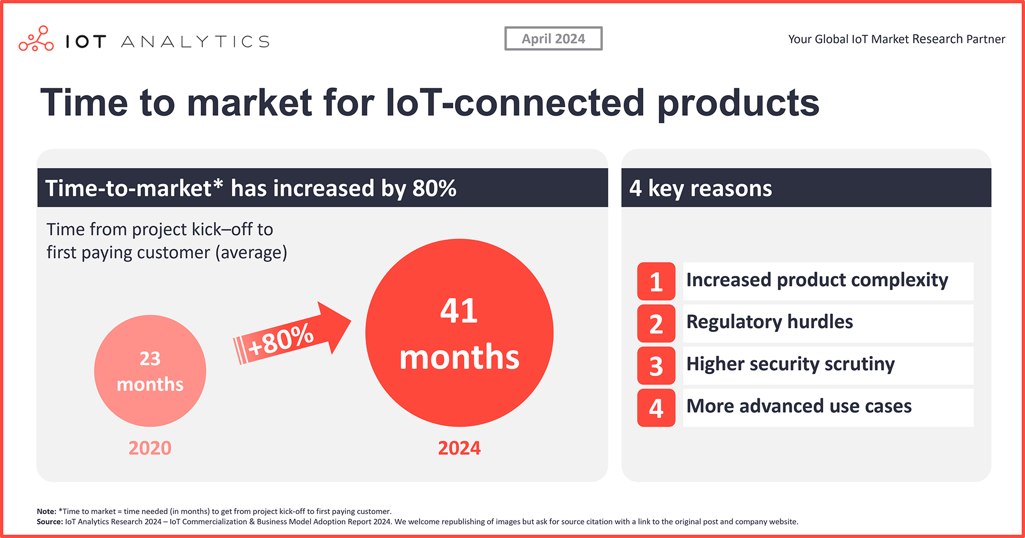
Figure 1. The time to market for IoT connected products increased 80% from 2020 to 2024. Source: IoT Analytics.
But what do we mean by enterprise grade? At Cumulocity, we have identified six core capabilities that we feel are critical to ease building, deploying, and scaling digital solutions, and that therefore form the key focus of our product development activities.
Question for discussion: Are there other features that you find critical to creating true enterprise grade solutions? What is most important for your product development journey?
Device connectivity and management at scale
As deployments grow to include a wide variety of devices and to hundreds, thousands, and even millions of endpoints, bespoke connectivity solutions become unworkable. Depending on the environment and existing infrastructure, it may be necessary to integrate devices using a variety of protocols, from OPC-UA to MQTT to LwM2M. An enterprise grade platform must provide a simple method for bulk connection and management of devices throughout their lifecycle.
Learn more about device connectivity from the Cumulocity documentation.
Data management
It is not enough to generate data at the asset level. To make the data valuable, you need to 1) make it accessible throughout the organization and 2) store data in a financially responsible manner. An enterprise-grade platform removes complexity linked to data management so you can ensure the quality, security, privacy and currency of your data.
AI & analytics
IoT analytics includes a range of techniques – including rule engines, event stream processing, data visualization, and machine learning – that together contribute to successful and scalable IoT projects. A platform must be able to incorporate all these techniques into the solution.
Read more about the integration of AI + IoT technology.
Integration with any architecture or system
An AIoT platform simplifies data integration with any architecture and any system to help you put your data to work. It’s a critical step to scaling your IoT solutions throughout your organization and with external partners.
Application enablement and management
Solution developers need the ability to deploy and deliver IoT solutions quickly, effortlessly, and seamlessly, taking full advantage of the scalability and reliability of the cloud. With a range of pre-configured applications that can be easily customized, an IoT platform enables you to build applications fast, scale as needed, and show faster ROI.
Deploying from the edge to the cloud
IoT solutions are deployed in a variety of environments with limited connectivity, or with restricted connectivity due to cybersecurity threats. A solution that can operate the same on the edge as in the cloud is critical.
For more detailed information, visit the Cumulocity Edge documentation.
Want to learn more?
Take a look at how organizations across industries are creating more resilient revenue with AIoT.